Shoe Cabinet Showdown: Veneer vs Solid Wood Over 5 Years in a Tampines HDB
I keep a mental tally of every shoe cabinet that walks through my showroom in Foshan, and last month I visited a friend's new 4-room HDB in Tampines to see how his two-year-old entryway storage was holding up. His unit cost him S$420 at a Jurong East furniture mall, made of pressed chipboard with a paper veneer finish. Two years in, the bottom panel had already sagged under three rows of trainers, and a corner near the corridor door had swollen from a small water spill he mopped up within minutes. That single visit pushed me to run the numbers properly for anyone in Singapore choosing between a veneer shoe cabinet and a solid wood one, because the true cost rarely shows up on the price tag.
This guide is written for HDB flat owners in Tampines, Bedok, and Punggol, condo residents dealing with narrow service lift openings, and anyone who has Googled shoe cabinet prices at midnight. I will walk you through the real 5-year cost, the construction differences, the Singapore-specific delivery headaches, and a few design questions that hinge on lifestyle rather than catalogue photos. I will also touch on adjacent pieces — a solid wood sofa, a bed frame, a dining table, a wardrobe, a nightstand, and a marble table — because the same logic that protects your entryway cabinet applies across a whole home purchased from a maker like MIDHILL, which has shipped solid wood pieces from Foshan to 15+ countries since 2008.
What is the real 5-year cost difference between a veneer and a solid wood shoe cabinet in Singapore?
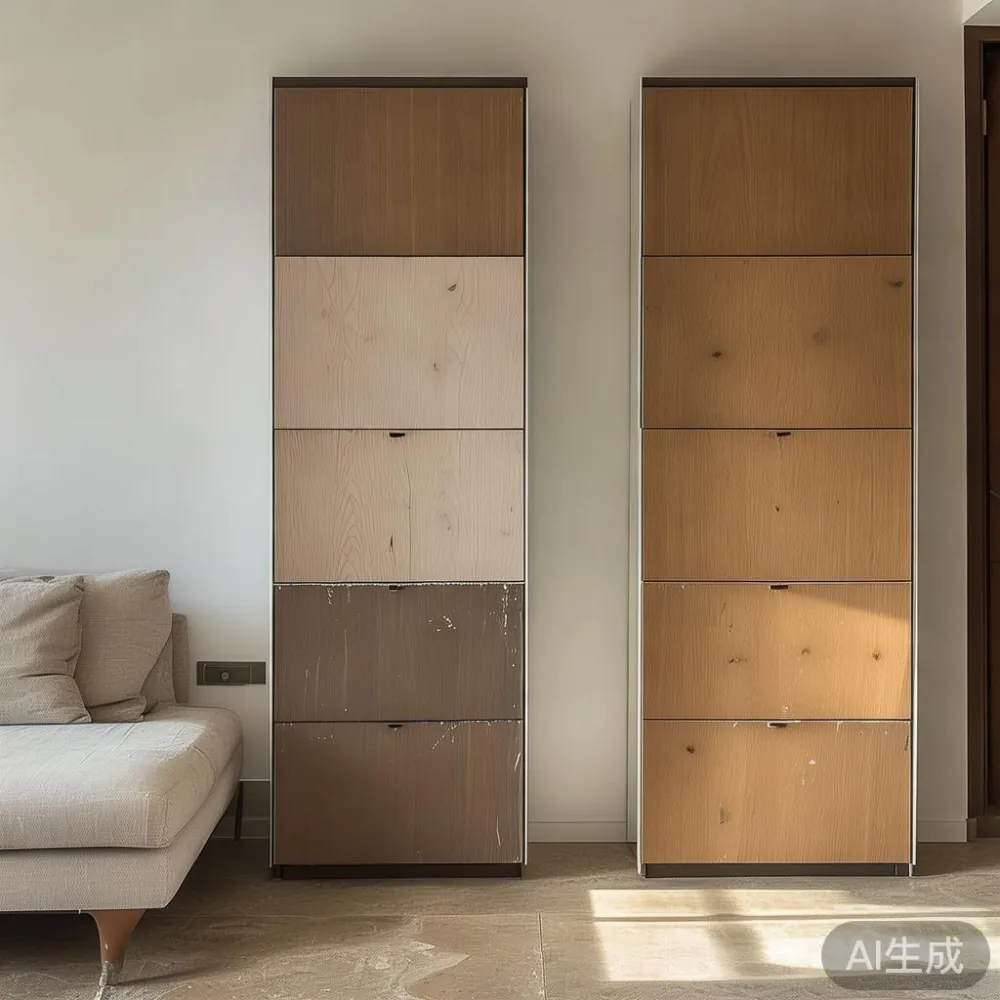
Let us anchor the comparison with concrete numbers from the local market. A standard two-door shoe cabinet in Singapore, roughly 80 cm wide × 120 cm tall × 35 cm deep, sells for S$320 to S$550 in particleboard with melamine veneer. The same dimensions in solid rubberwood or ash, finished with a water-based matte lacquer, run from S$780 to S$1,350 depending on joinery and hardware. That gap of roughly S$450 to S$800 at checkout is what most shoppers compare.
Now spread that gap across five years. The veneer cabinet, under HDB corridor humidity that swings between 70% and 85% RH during the November to January monsoon, typically shows edge-banding peel at the corners in 18 to 24 months. A hinge replacement costs about S$45 in labour plus S$18 for soft-close hinges, and most owners do this twice within five years, totalling S$126. Particleboard swelling, if a wet shoe drips, runs S$80 to S$200 for a partial panel repair or full replacement. Add one replacement cabinet at year four (S$420 the second time, since cheap units tend to be replaced not repaired), and the 5-year landed figure climbs to roughly S$700 to S$900.
The solid wood shoe cabinet, by contrast, uses through-tenon or dowel joinery that does not rely on glue lines near the floor. It handles a wet umbrella stand, monsoon humidity, and the daily scrape of school shoes without losing shape. Maintenance over five years is usually one round of touch-up lacquer at S$60 to S$90, plus a hinge check at no cost if the maker offers lifetime refinishing — MIDHILL includes lifetime refinishing on structural pieces, which is unusual in this price band. Total 5-year cost: roughly S$850 to S$1,440, only about S$150 higher than the veneer path, and you still own a usable cabinet at the end. When you divide the difference by 60 months and by the 12 to 18 pairs of shoes it stores, the monthly cost of going solid works out to less than a kopi at S$2.50.
Why does construction method matter more than wood species for an HDB shoe cabinet?
Most Singapore shoppers fixate on the wood name — rubberwood, oak, walnut, ash — when the make-or-break detail is how the panels are joined and how the edges are sealed. A cabinet built from solid rubberwood with butt joints and staples can fail faster than a well-engineered plywood with proper edge-banding. Two construction markers matter for our climate.
First, edge sealing. HDB corridor air in Punggol and Bedok often carries more moisture than the living room, because lift lobbies vent directly to the stairwell. An unsealed MDF edge absorbs that moisture within months. Solid wood, by nature, has no engineered edge to peel. The end grain on a solid panel can be sealed with a single coat of lacquer during manufacture and refreshed every few years.
Second, load-bearing geometry. A solid wood shoe cabinet for a family of four typically holds 16 to 22 kg of shoes. Particleboard shelves can bow at the midpoint after 18 months if the cabinet is wider than 90 cm, which is why so many Jurong East flat-pack owners add a centre support leg as a retrofit. A solid wood shelf of 18 mm thickness, properly oriented with the grain running front-to-back, holds that weight without flex for a decade or more. This same principle is why a MIDHILL solid wood sofa frame and bed frame feel heavier at the showroom, and why they carry a 10-year structural warranty that flat-pack rivals cannot match.
How does Singapore delivery and installation change the cost math for a 90 cm wide cabinet?
Local delivery is where the cheap veneer cabinet often surprises buyers with hidden fees. A typical HDB in Tampines or Punggol has a service lift opening of about 90 cm wide × 210 cm tall, and corridor turns at the lift lobby can be as tight as 1.2 m. A flat-pack shoe cabinet in two boxes arrives easily, but a fully assembled solid wood cabinet of 90 cm × 120 cm × 35 cm needs to clear that 90 cm lift door. Most Foshan workshops, including the one I work with, ship flat-pack with simple dowel assembly that two people can complete in 25 to 40 minutes using a single hex key.
Shipping costs from Foshan to Singapore for a single cabinet range from S$85 to S$140 by sea LCL, with 18 to 28 working days transit plus 9% GST on the landed value at Singapore customs. Orders above US$350 from MIDHILL ship free, which means a single cabinet bundled with a nightstand or a marble table side panel qualifies. Flat-pack alternatives from local megastores list free delivery but typically add S$30 to S$60 for lift-up landings above the 7th floor, and another S$40 for weekend slots.
Return policy matters if the cabinet arrives damaged. Most Jurong East outlets offer a 7-day exchange, whereas MIDHILL offers 14-day returns on standard pieces. Over five years, the chance you will use that return window is small, but for a purchase above S$800 it is worth a few dollars of the price.
How do light-luxury design styles change the way a shoe cabinet looks after five years?
Style choice has a hidden cost in maintenance time, not just dollars. A French light luxury shoe cabinet typically features a cream-painted finish, slim shaker panels, and slim brass knobs. The painted finish is the weak point: chips at the toe-kick from shoes coming off, and yellowing under UV exposure near the corridor window. A touch-up kit costs S$25 and takes an hour if you are handy.
American light luxury, with its thicker frames, darker walnut tones, and visible grain, ages more forgivingly. Small scratches blend into the grain pattern rather than standing out against a cream surface. Post-modern light luxury leans on high-gloss lacquer or stone inlays, which look striking on day one but show fingerprints within a week. For an HDB entryway where shoes are kicked off by children, a matte, open-grain finish tends to be the most forgiving over five years.
Whichever style you pick, keep the cabinet at least 5 cm off the floor on solid wood legs or a plinth base. This single detail prevents the most common damage I see in Singapore homes: wicking moisture from wet mopping.
How do I match a shoe cabinet with a dining table, bed frame, and wardrobe without breaking the budget?
Many buyers in Singapore furnish an entire HDB in phases, and the shoe cabinet is often the first piece because it solves an immediate storage problem in the entryway. The trick is to choose a wood tone and construction standard that you can repeat later on a dining table, a bed frame, and a wardrobe without paying a premium each time.
Step one: pick a species. Rubberwood is the most common in our Foshan workshops because it is sustainably sourced from plantation latex trees, machines cleanly, and accepts a wide range of stains from pale ash to dark walnut. White oak and ash cost 20% to 35% more but photograph beautifully if you want a Japandi look.
Step two: pick a joinery standard. If you choose dowel-and-bolt construction on the shoe cabinet, you can specify the same standard on a dining table and bed frame later, which keeps the pieces visually consistent. A MIDHILL dining table uses mortise-and-tenon on the apron and a bolted leg-to-top connection, a method that survives five moves across HDB blocks.
Step three: match the hardware finish. If your shoe cabinet has brushed brass pulls, source the same finish for your wardrobe and nightstand handles. Hardware is the cheapest way to tie a home together.
Step four: think about marble carefully. A marble table or marble-topped nightstand is heavy, around 35 kg for a 50 cm square top, and requires a reinforced cabinet if you plan a built-in look. For HDB, a marble-look sintered stone slab over solid wood is lighter at about 18 kg and ships without the cracking risk.
Is a solid wood Mid-century modern shoe cabinet worth the extra dollars in a small HDB entryway?
This is the question I get most often from buyers in Bedok and Punggol who have only 90 cm to 110 cm of entryway wall. The short answer: yes, if you choose the right proportions. Mid-century modern styling suits HDB because it relies on slim tapered legs and a low visual profile, which makes a narrow corridor feel larger. A solid wood shoe cabinet in this style, around 80 cm wide × 95 cm tall × 32 cm deep with four compartments, sells in our showroom range for S$880 to S$1,050.
The value shows up in two places. First, the tapered legs raise the cabinet 18 cm off the floor, which means you can slide a thin tray of wet umbrellas underneath during the monsoon. Second, the open-grain walnut or teak finish hides the dust that inevitably collects at the toe-kick, unlike a gloss white finish that shows every footprint. If you are researching how to choose Mid-century modern sofa and how to choose Mid-century modern sofa pieces for the living room, the same proportions and leg geometry apply — a 180 cm sofa with a 42 cm seat height feels coherent next to a 95 cm shoe cabinet, because the eye reads the horizontal lines together.
For buyers who prefer a softer French silhouette, the question of how to choose French sofa and how to style French provincial bed in apartment comes up alongside the entryway choice. A French provincial shoe cabinet, with a curved cornice and fluted side panels, reads more formal and pairs well with a French sofa in the living room, but it adds visual weight to a 90 cm corridor. In a Tampines 4-room flat I visited last month, the owners chose a flat-front French-inspired shoe cabinet with a soft-curve top rather than a full provincial cornice, and the result felt airy.
Where does French sofa vs Japandi sofa and industrial furniture fit into a Singapore home that already has a solid wood shoe cabinet?
Once the entryway is sorted, buyers ask how the living room pieces should relate to it. The French sofa vs Japandi sofa comparison is less about right and wrong than about light. A French sofa, with a rolled back, skirted base, and pale linen, reads warm and traditional. It pairs with a cream-painted shoe cabinet and a marble table top in the dining area. A Japandi sofa, lower to the ground with a solid wood base and neutral wool, pairs with an open-grain walnut shoe cabinet and a matching dining table.
Industrial furniture for sale in Singapore usually means blackened steel frames combined with reclaimed-look solid wood. This style works well in Punggol Waterway terraces and in condo loft conversions in the city fringe. If your shoe cabinet is solid wood with a black steel kick plate, you can extend the same steel-and-wood vocabulary into a TV console, dining bench, and bookshelf, and the whole home reads as one decision rather than a collection of mismatched pieces.
A note on mixing: do not put a high-gloss lacquer shoe cabinet next to a matte raw-wood dining table. The contrast will look like an accident rather than a choice. Pick one finish family per room and carry it through.
What about warranties, refinishing, and the resale math at year five?
Warranties are where solid wood quietly wins. A 10-year structural warranty on joinery, the kind MIDHILL includes with every cabinet, sofa frame, and bed frame, covers the most expensive failure modes: broken dowels, cracked legs, and split panels. Veneer cabinets rarely carry more than a 12-month warranty because the maker knows the edges will lift.
Lifetime refinishing sounds like marketing language until you use it. After three to five years, a solid wood shoe cabinet that has picked up surface scratches can be sanded and re-lacquered at the workshop for a fraction of replacement cost. MIDHILL offers this service for the original purchaser, which means a S$900 cabinet bought today can look new at year five for a S$120 service fee. Try asking a Jurong East flat-pack seller for that.
Resale math: a five-year-old solid wood shoe cabinet in good condition sells on Carousell for 50% to 65% of its original price. A five-year-old veneer cabinet sells for 10% to 20%, if it survives the listing photos at all. On a S$900 purchase, that gap is roughly S$300 to S$450 of recovered value, which alone closes the upfront price gap with a veneer unit.
My honest 5-year recommendation for a Singapore shoe cabinet buyer
If your budget caps at S$500 and you are renting a room for one or two years, a flat-pack veneer shoe cabinet is the right call. The upfront savings matter more than longevity. If you own your HDB or condo, plan to stay five years or more, and want a piece that will still look presentable when you renew your passport photo, spend the extra on solid wood. Aim for 18 mm solid panels, dowel joinery, a matte or satin lacquer, and a maker that puts a 10-year structural warranty in writing.
Two practical tips before you click buy. First, measure your lift opening and the tightest corridor turn, not just the wall where the cabinet will live. A 5 mm difference between the cabinet width and the lift opening is the most common reason for a failed delivery in Punggol and Bedok. Second, ask for the workshop email — for MIDHILL that is midhillco@gmail.com — and request shop photos of the actual cabinet you will receive, not just a styled catalogue render. A maker who answers with three workshop photos and a workshop video on the same day is a maker who will answer your warranty claim in year three.
The 5-year cost difference between veneer and solid wood in Singapore is smaller than it looks on the price tag, and it flips in your favour the moment you account for one replacement, one refinishing, and one resale. A shoe cabinet is the first piece of furniture your guests see and the last one you close at night. It deserves a construction standard that outlasts your tenancy.