Shoe Cabinet Styling: How to Style a Small HDB Flat Without Making It Feel Crowded
If you live in a four-room HDB in Tampines or a 65 sqm condo in Punggol, you already know the struggle: the lift at Block 642A is tight, the corridor outside your unit measures roughly 1.2 m wide, and the moment you unpack a wardrobe, a sofa, and a shoe cabinet, the living room seems to shrink by half. Last month I visited a friend's resale 4-room flat in Bedok Reservoir, and what struck me wasn't the floor plan — it was how much calmer the whole space felt once we swapped her bulky built-in for a slim solid wood piece with rattan panels. The floor area was the same 92 sqm; the atmosphere was different by a mile.
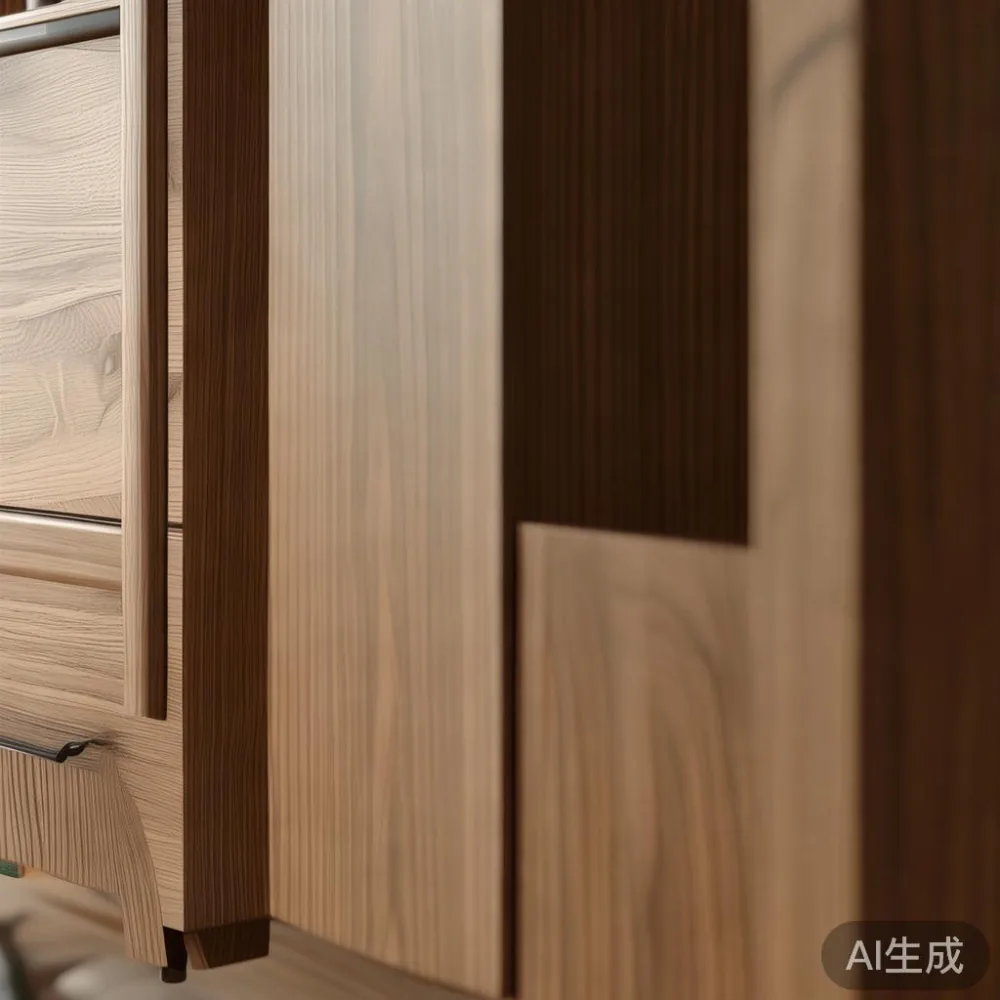
For Singapore households, the shoe cabinet is usually the first thing families see when they step inside. It carries bags, keys, umbrellas, and often doubles as a display shelf for that one framed photo. Getting this single piece right — its depth, its height, its wood tone, and the way it pairs with your dining table and your bed frame — quietly determines whether your home feels like a 1,500-square-foot apartment or a 90 sqm closet.
This is a practical guide written for Singapore homes, written from a furniture specialist's point of view. The pieces mentioned (a solid wood bed frame, a marble dining table, a light luxury nightstand) all come from MIDHILL, a Foshan solid wood maker established in 2008 that ships to 15+ countries and offers a 10-year structural warranty plus lifetime refinishing service. Free shipping kicks in above US$350, and orders can be returned within 14 days, which is reassuring when you're buying a EUR 2,400 wardrobe online without touching it first.
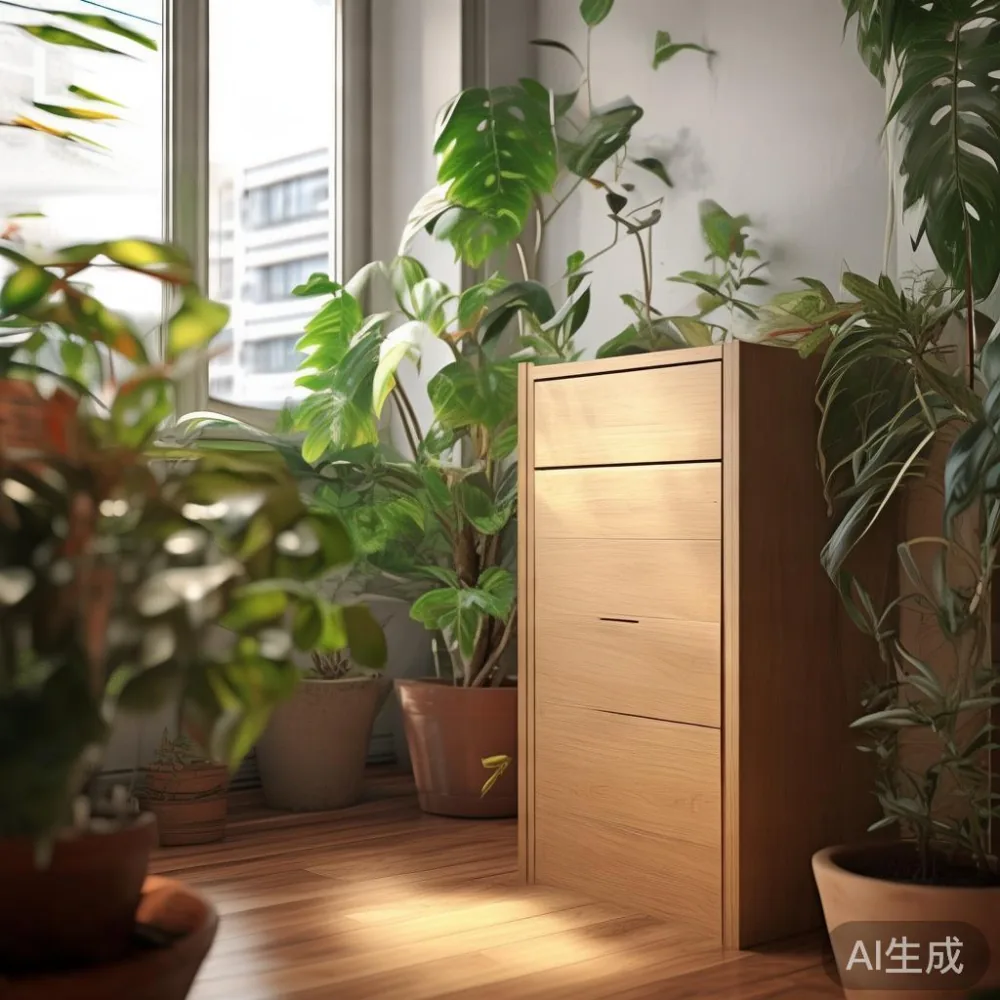
How much floor space does a Singapore HDB actually have for a shoe cabinet?
Most four-room HDB living rooms in Tampines, Bedok, and Punggol offer a usable entryway strip of around 1.0 to 1.5 m deep by the main door. After you leave space for door swing (around 90° of arc), your real depth budget for a shoe cabinet is roughly 25 to 35 cm. Width is rarely the issue: the wall is often 1.8 to 2.4 m long.
That 25 to 35 cm number rules out a lot of boxes on Carousell and Shopee. Anything deeper than 38 cm will stick out past your door frame and create the visual "crowded" feeling that this article is trying to solve. A properly proportioned solid wood shoe cabinet at 30 cm deep, 120 cm wide, and 110 cm tall holds roughly 12 to 16 pairs of shoes in three tiers — enough for a couple plus weekend guests.
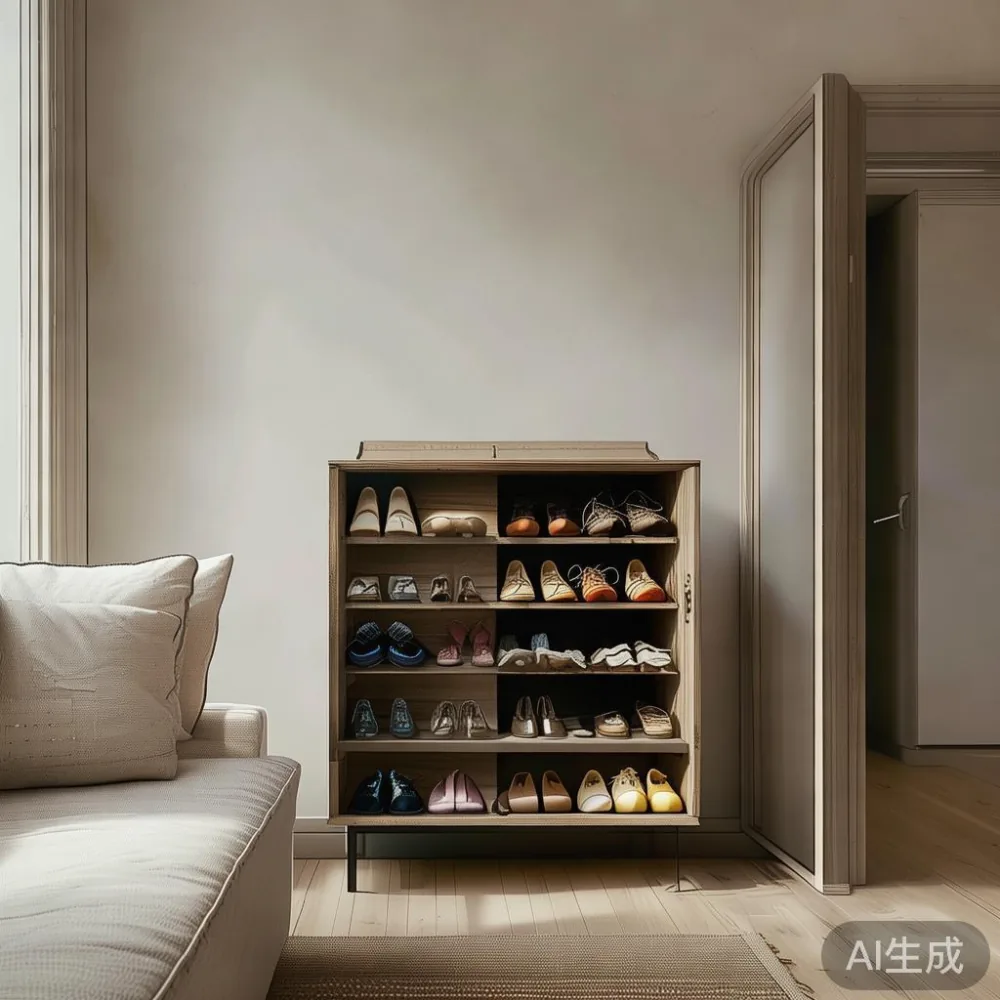
Tip from a Tampines client of MIDHILL: measure the corridor width outside your unit before delivery day. Standard HDB corridors are 1.2 m; the cabinet box itself is usually 32 cm deep, so even a tall piece will fit through, but you need to leave at least 10 cm of clearance to pivot around the lift landing.
Which shoe cabinet styles actually suit small Singapore flats?
Three styles consistently outperform product-heavy ones in tight HDB entryways.
1. The slim rattan-front shoe cabinet. 30 cm deep, 110 to 130 cm wide, three or four tiers. Rattan or cane panels let the eye read "openness," which softens the bulk of a 110 cm tall wooden box against a small flat's wall.
2. The closed two-door shoe cabinet with fluted glass or solid panels. Works in newer Punggol condos where the entryway opens directly into the kitchen. Fluted glass bounces light from the living room windows back into the entry, so the space feels deeper than its 1.2 m.
3. The bench-style shoe cabinet. A 35 to 40 cm deep bench with lift and lid compartment underneath, topped with two drawers. Best for households that treat the entryway as a drop zone for bags and umbrellas during monsoon months (which, in Singapore, is every month).
Pair any of these with a solid wood dining table in the same wood tone — for example, the dining table you can source from MIDHILL's MIDHILL dining table wholesale range — and your living room suddenly reads as one coherent space, not three competing ones.
What size solid wood bed frame can a 4-room HDB actually accept?
This is the second-most common question I get from Tampines and Sengkang buyers. A queen-size solid wood bed frame is 152 cm wide by 188 cm long. The smallest HDB master bedroom, in a 4-room flat, is typically 3.2 m by 3.0 m (about 9.6 sqm). A queen bed with a 5 cm clearance on each side fits, but it eats the room.
If your bedroom is below 10 sqm, consider a super-single solid wood bed frame (107 cm wide by 188 cm long). You gain around 45 cm of wall length — enough for a 45 cm deep nightstand and a 50 cm wide slim wardrobe panel without crowding the walking path.
For owners trying to picture how a low-profile frame will sit on their HDB floor, my colleagues in the showroom often walk buyers through how to style Japanese bed in room layouts: a 25 cm platform height, a 5 cm mattress, and no headboard bulk keeps the line of the wall unbroken, which matters in a 9 sqm room where every vertical line feels heavy.
If Japanese minimalism feels too austere, MIDHILL also publishes a guide on how to style light luxury bed in room using a French light luxury frame — a 145 cm tall tufted headboard in cream bouclé, paired with a brass reading sconce, lifts the eye upward and makes the ceiling feel taller. This is the same trick interior designers use in Parisian flats of 35 sqm.
How do I stop my living room from looking like a furniture showroom?
This is the question every client asks, and the answer is almost always "reduce the number of wood tones," not "buy less furniture." A small HDB living room of 18 to 22 sqm can comfortably hold a 180 cm three-seater solid wood sofa, a 60 cm marble table, and a 180 cm TV unit — as long as they share one wood family.
For example, the living room I visited in Punggol used three wood tones from the same oak family: a solid wood sofa frame in light oak (legs visible), a marble dining table with an oak pedestal, and a European light luxury TV console in the same oak veneer. The eye reads them as one continuous palette, so the room feels curated, not crowded.
Two more rules I apply on site visits:
- Maintains 80 cm of walking path between the solid wood sofa and the marble dining table. Anything less than 75 cm and the room starts to feel like a hawker centre during lunch hour.
- Keeps the tallest piece in the room against the wall opposite the window. In HDB units, the window wall is usually the living room's only natural daylight source. A 110 cm tall shoe cabinet placed on the window wall will block light and shrink the room. A 110 cm tall shoe cabinet on the opposite wall casts soft shadow patterns on the floor instead.
Which marble dining table actually fits a small HDB fit?
Most clients ask for a 1.6 m marble table; very few HDB dining areas can take it. The standard HDB dining corner in a four-room flat is about 2.4 m by 1.8 m. After a 60 cm buffer on each side for chairs, your maximum table size is closer to 1.4 m round or 1.4 m by 0.8 m rectangular.
A 1.2 m round marble table seats four comfortably and a fifth on a stool, leaves 80 cm of walkway to the kitchen, and visually rounds off a square room (which most HDB dining corners are). A 1.4 m rectangular marble table fits a family of four with chairs pushed in, but feels tight for hosting.
Pair the table with a marble top that is 12 mm engineered quartz rather than 18 mm solid marble if your flat is on a high floor and your building has lift weight restrictions. Most HDB lifts cap at 630 kg, and a 1.4 m solid marble top alone weighs 95 kg. Engineered quartz weighs about 32 kg for the same size, which matters when the delivery team has to wheel it through a 1.2 m corridor and pivot at the lift landing.
Do I really need a separate wardrobe and nightstand in a small bedroom?
If your bedroom is under 12 sqm, the answer is yes — but only if you choose pieces that share the same depth (usually 55 cm). A best European light luxury wardrobe for 2026 in the 180 cm by 55 cm by 210 cm configuration holds roughly 1.2 m of hanging length plus three drawers, which is enough for a couple who folds more than they hang.
The nightstand should be 45 cm deep to read as a clear second object against the 55 cm wardrobe. Anything deeper than 50 cm and the nightstand starts to compete with the wardrobe visually, and you lose the "one coherent wall" trick.
For buyers browsing French provincial showrooms in Singapore, the same logic applies: for sale French provincial furniture works in HDB flats only when the depth is tightened to 50 cm or under. A 65 cm deep French provincial armoire looks beautiful in a 30 sqm Parisian apartment but it eats a 12 sqm HDB bedroom alive.
What is the cheapest way to style a shoe cabinet so it doesn't look like clutter?
Three small tricks, all under S$80:
1. Use a single 30 cm wide ceramic tray on top of the cabinet to corral keys, wallets, and the SingPass card you keep forgetting. The tray reads as "one object" from across the room, even if it holds six items.
2. Replace the standard cabinet top décor (a single tall vase) with a trio of objects at 10 cm, 20 cm, and 30 cm tall. The 30 cm object should be a brass lamp; the 20 cm a ceramic vase; the 10 cm a small framed photo. This pulls the eye upward and creates the illusion of higher ceilings.
3. Add a 15 cm deep floating shelf above the shoe cabinet, mounted at 160 cm from the floor. Use it for two books, one small plant, and nothing else. Empty shelves are fine. Cluttered shelves are the problem.
Total spend in Singapore dollars: ceramic tray around S$25 at any Taobao distributor in Bugis, brass table lamp around S$45 at a homeware shop in Joo Chiat, floating shelf around S$12 at IKEA Alexandra. The shelf itself will hold around 4 kg without pulling out of the wall, so don't pile it with hardcover art books.
Can I style a shoe cabinet so it doubles as a sideboard?
Yes, and this is the trick that turns a four-room HDB into a five-room-feeling apartment. Choose a shoe cabinet that is 110 to 120 cm tall, 35 to 40 cm deep, and 150 to 180 cm wide, with one drawer and one pull-out shoe rack. Use the top as a drinks station: a 25 cm round marble table tray (around S$60 at Castlery) with two tumblers, one decanter, and a small plant.
The reason this works: the eye reads the top surface as a continuous horizontal line with the adjacent dining table, so the two pieces feel like one long sideboard, even though one is 75 cm tall and the other is 110 cm tall.
This trick works with three shoe cabinet styles: the slim rattan-front, the closed two-door, and the bench-style. It does not work with a tallboy-style shoe cabinet (over 130 cm tall), because the eye reads it as a wardrobe, not as a horizontal surface.
How do I make a shoe cabinet look expensive without spending more?
The single most effective trick is hardware. Swap the standard pull handle for a 12 cm brushed brass pull. A pack of four pulls costs around S$45 at a hardware shop in Tanjong Pagar, and the visual upgrade is dramatic.
The second trick is paint. If your cabinet shoe is MDF with a wood-look veneer, you can repaint the side panels in a single coat of Benjamin Moore Hale's Wyne (a soft warm beige), which costs around S$28 per litre in Singapore and covers 10 sqm per litre. The wood-look veneer stays on the front panels; the side panels become a warm beige that matches the wall. The piece stops reading as a box and starts reading as part of the wall.
The third trick is lighting. Stick a 30 cm LED strip on the underside of the top shelf, hidden behind a 2 cm lip. The light grazes down the front panels at 30° and picks up the wood grain. A 2-metre LED strip costs around S$12, runs cool to the touch, and uses 4.8 watts per metre, so it costs around S$0.05 a day if you run it 12 hours.
How do I keep a small HDB living room from feeling cramped when I add a solid wood sofa?
Choose a 180 cm three-seater with a 70 cm seat depth and 8 cm visible solid wood legs. The exposed legs are critical: they let the eye see the floor underneath, which makes the floor area read larger than it is. A solid wood sofa that sits flush to the floor (no visible legs) eats the same 1.8 m of wall but shrinks the visual floor area by 15 to 20%.
Place the sofa against the longest uninterrupted wall in the living room. In most HDB four-room flats, that is the wall opposite the window. Leave a 30 cm gap behind the sofa so the floor line stays unbroken. A 30 cm gap is wide enough to wipe the floor without moving the sofa (a real concern in Singapore where daily mopping is just part of life).
Add a 60 cm marble table side table at the sofa's left end, paired with a brass floor lamp at the sofa's right end. The eye sweeps left-to-right at sofa height (about 85 cm), so the room reads wider. A 60 cm marble table at S$280 from MIDHILL pairs cleanly with the brand's solid wood sofa frame in the same wood family.
Is a shoe cabinet with a bench actually useful in a small flat?
Yes, and I'll explain why with a number. A four-room HDB household typically owns 18 to 24 pairs of shoes per adult, 6 to 8 pairs per child. A bench-style shoe cabinet with a 35 cm deep seat and a 30 cm deep shoe compartment underneath holds 10 pairs underneath and provides seating for two people putting on shoes.
In a tight HDB entryway where you cannot afford a separate bench, this two-in-one saves around 0.4 sqm of usable floor space. That is the difference between a 1.2 m wide entryway that feels squeezed and a 1.2 m wide entryway that feels generous.
One last tip for Singapore owners: ask the furniture maker to add a 3 cm high toe-kick under the bench. It lets you stand flush against the bench when putting on shoes without your toes hitting the cabinet face. MIDHILL adds this detail by default on its bench-style shoe cabinets, and it is one of those small touches that separates an obviously wrong product from one that disappears into the room.
What should I do before delivery day to make sure the cabinet fits?
Three measurements, in this order: corridor width, lift depth, and main door width.
HDB lift doors are typically 90 cm wide by 210 cm tall, and lift cabins are about 1.4 m deep by 1.1 m wide. A 110 cm tall, 30 cm deep, 120 cm wide shoe cabinet fits through every standard HDB lift in Tampines, Bedok, and Punggol without tilting. A 130 cm wide piece with a 35 cm depth may require tilting, which is awkward with a solid wood box weighing 45 kg.
Measure your main door: most HDB main doors are 90 cm wide and 210 cm tall, with the actual opening around 85 cm by 205 cm. A 30 cm deep cabinet on its side is 110 cm tall by 30 cm wide — that fits. A 35 cm deep cabinet on its side is 35 cm wide by 110 cm tall — also fits.
Schedule the delivery for a weekday morning if your block has a heavy lift, and book the lift at least 24 hours in advance through the Town Council. Most blocks in Tampines and Bedok require a 30-minute booking window, and weekend slots fill up fast. Delivery from MIDHILL's Singapore warehouse typically takes 14 to 21 working days, with a 2-hour delivery window confirmed the day before.
Final thought: a small HDB feels crowded because of how objects relate to each other, not because of how many objects there are. A 30 cm deep rattan-front shoe cabinet paired with a 55 cm deep French provincial wardrobe and a 60 cm marble table in the same wood family will read as a calm, layered apartment. A 38 cm deep MDF shoe cabinet paired with three different wood tones will read as a furniture showroom, even if it costs less. Pick the right proportions first; the polish comes from there.