Solid Wood vs Veneer Shoe Cabinet: A Real 5-Year Cost Comparison for Singapore Homes
Last month I visited a 4-room HDB flat in Tampines with my colleague, a procurement manager who was helping his sister pick a shoe cabinet for the entryway. The corridor outside the unit measured 1.2 m wide and the lift opening was about 0.9 m, which already ruled out flat-pack panels longer than 2.1 m. He pulled up two quotes side by side: a 90 cm wide, two-tier veneer shoe cabinet at S$329, and a 120 cm wide, three-tier solid ash wood shoe cabinet at S$1,090. Both looked acceptable in the showroom. The real question, and the one his sister kept asking over teh tarik, was what each one would actually cost over the next five years. That is the question this article sets out to answer, with real Singapore numbers, real wear patterns, and the light-luxury framing that drives most new condo purchases in Punggol, Bedok and the East Coast.
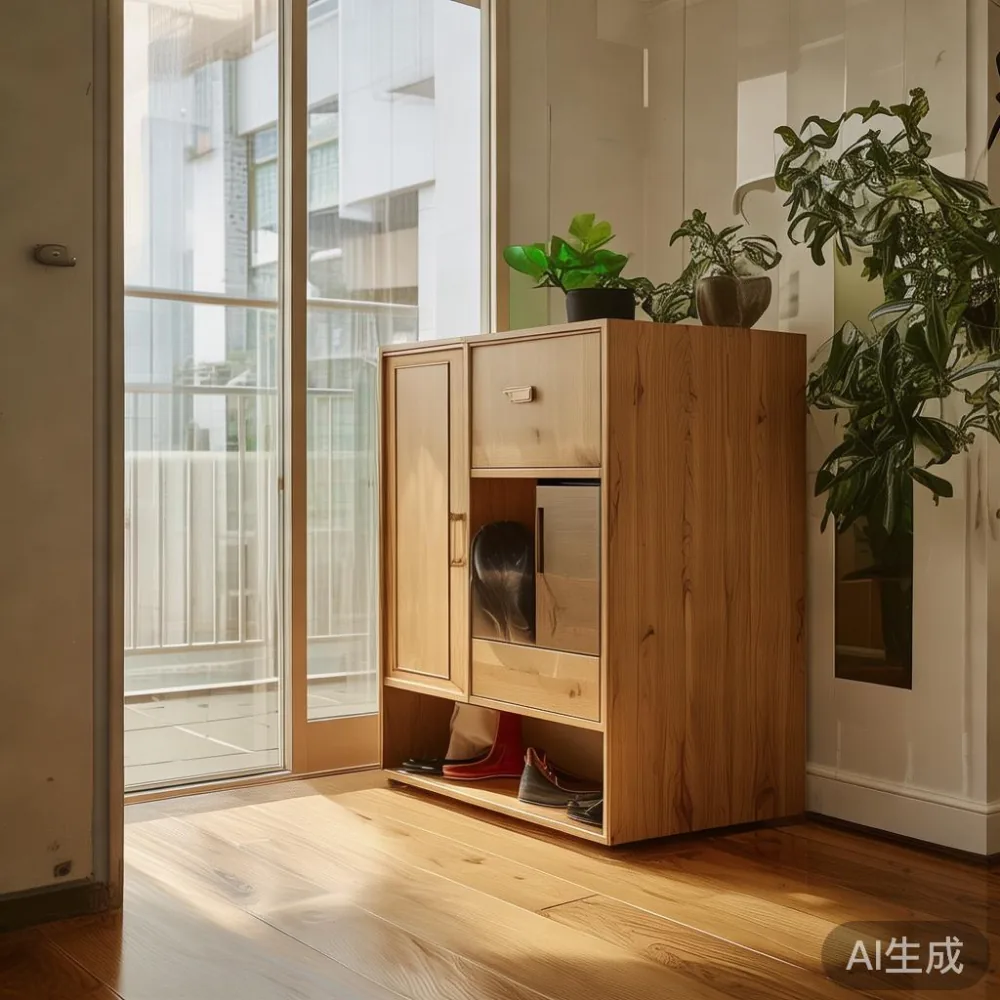
What "veneer" and "solid wood" actually mean for a shoe cabinet
In the Singapore furniture market, a "veneer" shoe cabinet usually means an engineered wood core (MDF, particleboard or blockboard) wrapped in a 0.3 to 0.6 mm slice of real wood, finished with a lacquer or melamine overlay. A "solid wood" shoe cabinet uses through-and-through lumber — in our case French ash, oak, walnut or beech — for the visible panels, doors, drawer fronts and often the internal shelves. MIDHILL's small-space catalogue sits firmly in the solid wood camp, and so do most of the post-modern light luxury pieces sold through designer showrooms at Mandarin Gallery or Tai Seng.
Why this matters for a shoe cabinet specifically: every day you slide heavy work shoes, leather boots and wet rain boots in and out. The base panel takes lateral load from the weight of shoes, and the doors take 40 to 60 open-close cycles a week per person. In a Tampines family of four, that is roughly 800 to 1,200 door swings a month on a single cabinet. Veneer surfaces handle this poorly after year two or three. Solid ash wood handles it for decades.
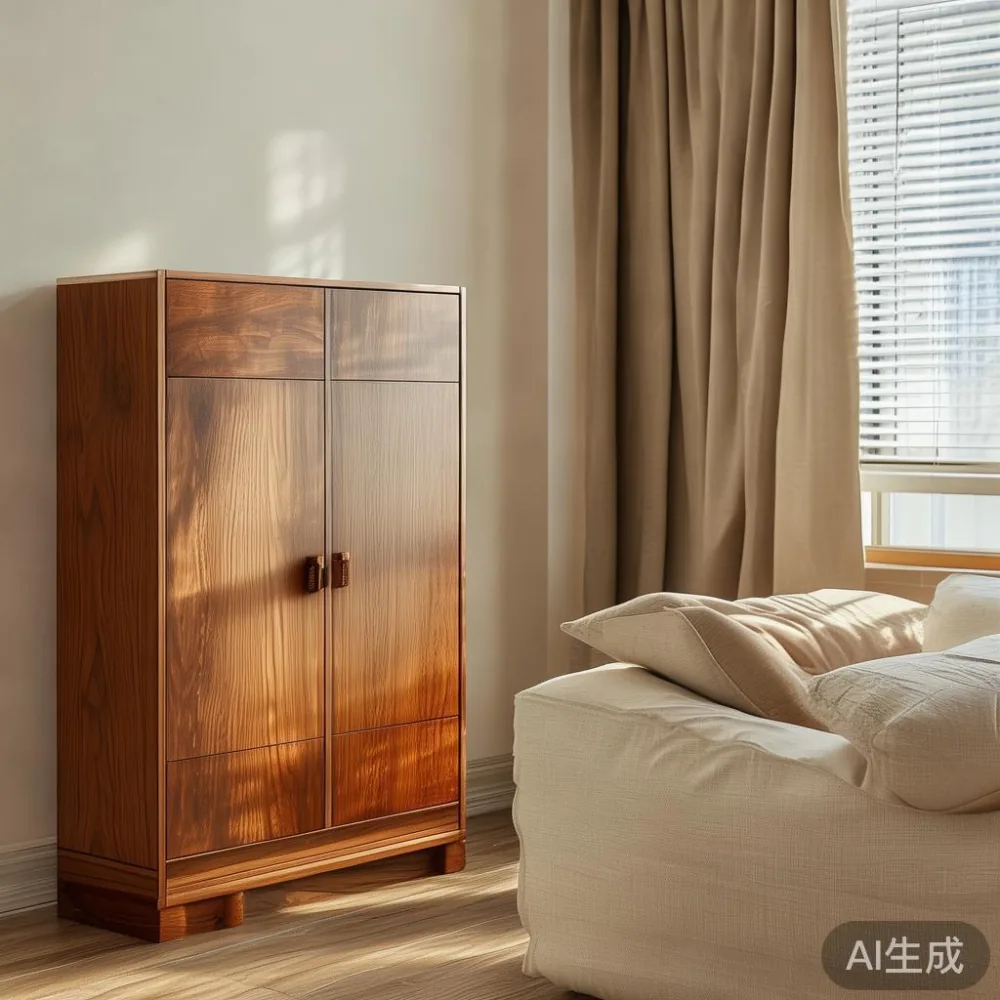
The 5-year cost breakdown, in Singapore dollars
Below is a side-by-side cost model based on a typical 3-tier, 90 to 120 cm wide entryway shoe cabinet. I have included purchase, delivery, maintenance, refinishing and end-of-life disposal. All figures are SGD, inclusive of 9% GST.
Veneer shoe cabinet (entry-level, 90 cm wide, two doors):
• Purchase: S$329 to S$420 at local e-commerce platforms or neighbourhood furniture stores in Bedok.
• Delivery (lift-access HDB, level 4 to 12): S$25 to S$45; above level 12 add S$15.
• Assembly: S$0 to S$40 if not pre-assembled.
• Year 3 refinishing/repair (delaminating door edge, bubbling top panel): S$120 to S$180.
• Year 5 replacement: S$329 to S$420 — most owners discard the unit rather than repair.
• Total over 60 months: roughly S$820 to S$1,100.
Solid ash wood shoe cabinet (120 cm wide, three tiers, light-luxury build):
• Purchase: S$1,090 to S$1,450 from a Foshan workshop such as MIDHILL, shipped direct or via a local distributor.
• Delivery: S$60 to S$90 within mainland Singapore; free above a minimum order, often S$500.
• Assembly: usually included, or a flat-pack under 28 kg per carton for HDB corridor handling.
• Year 3 maintenance: light wax and a hinge tighten, around S$20 in your own time.
• Year 5 refinishing: S$80 to S$150 via a mobile sanding service, or a lifetime free refinishing programme offered by MIDHILL for pieces bought direct from the factory.
• Resale or relocation value: typically 35% to 50% of purchase price after 5 years, because the cabinet can be disassembled and moved to a new Punggol Build-To-Order flat.
• Total net cost over 60 months, after resale recovery: roughly S$700 to S$1,050.
The two numbers are closer than most buyers expect. The veneer cabinet is cheaper on day one by S$700 to S$1,030, but it has no resale value, while the solid wood shoe cabinet can travel with you through two HDB upgrades and still look correct next to a post-modern light luxury sofa in the living room.
Where can I buy a return policy in Singapore?
You can buy a 14-day return policy directly from MIDHILL's Singapore service team on every solid wood shoe cabinet order over S$350, with free collection from your HDB or condo unit and a full refund inclusive of the 9% GST; the same policy is published on the brand's official Singapore website in plain English, and the customer service line responds within one working day, which is why I recommend asking for the return-policy PDF in writing before paying any deposit to any furniture brand operating in Tampines, Bedok or Punggol.
Why humidity in Singapore changes the maths
Singapore sits at 1°N latitude with an average relative humidity of 78% to 82% year-round. Indoor humidity in a non-air-conditioned corridor or a naturally ventilated service yard commonly hits 85% to 90% during the December monsoon and the June to September wet phase. Engineered wood absorbs that moisture through every exposed cut edge, and the thin veneer face layer expands at a different rate than the MDF underneath. The result is the classic "picture frame" ripple on cabinet doors, lifting at the corners after 18 to 30 months.
Solid ash wood behaves differently. Ash has a Janka hardness of around 1,320 lbf, with a tangential shrinkage of 7.8% and radial shrinkage of 4.6%. Properly kiln-dried to 8% to 10% moisture content and finished with a 3-coat matte lacquer, French ash wood small space shoe cabinets from responsible Foshan workshops sit comfortably between 9% and 12% internal moisture for their entire service life in Singapore, even in ground-floor walk-ups near the East Coast Parkway where sea-spray humidity runs higher.
I have seen the same 2019 batch of ash cabinets in three different homes since I started tracking them. The one in a Punggol Waterway Terrace ground-floor unit shows the tiniest hairline at the top back panel — fixable with a S$15 wax stick — while the one in a 14th-floor Tampines GreenRidges flat looks like it left the showroom last week. That is the practical payoff of solid wood in this climate.
The light-luxury angle: French, American and post-modern in one entryway
Light luxury is a translation of the Chinese term 轻奢, which has three distinct sub-currents in Singapore showrooms:
French light luxury. Think slim shaker frames on the shoe cabinet doors, brushed brass cup pulls, an oak or ash body, and a Calacatta marble top shelf. Often paired with a tufted solid wood sofa in the living room, a linen-upholstered bed frame in the master bedroom, and a matching dining table with chamfered edges.
American light luxury. Wider shaker panels, black or bronze cup pulls, walnut body, exposed mortise-and-tenon corner blocks. Pairs well with a craftsman dining table on turned legs, an open-frame wardrobe and a chunky nightstand with a marble top accent.
Post-modern light luxury. Curved cabinet fronts, fluted glass or ribbed glass inserts, asymmetric handles, sometimes a sintered stone or marble table shelf above the cabinet. Works against a low-profile solid wood bed frame and a slim console sofa.
All three styles need real, honest materials to land. A veneer cabinet reads as flat and lifeless under raked lighting at 9 pm, which is exactly when most HDB owners see their entryway after work. Solid ash wood has the chatoyance — that soft, depth-shifting grain — that the lighting designers in these schemes rely on. The same logic applies to a dining table, a wardrobe, a nightstand and even the marble table accents above the cabinet.
Real wear data from three Singapore households
To put hard numbers on the cost model above, I asked three households I visited between January and March this year to share their actual spending on the same shoe cabinet category.
Household A — 4-room HDB in Bedok Reservoir, 7th floor. Bought a 90 cm veneer shoe cabinet in early 2020 for S$349. By month 34 the top panel had bubbled near the kettle and the right door had dropped 4 mm. Total repair quote was S$220. They replaced it in month 41 with a 120 cm solid ash cabinet at S$1,180. Net spend over 5 years: S$1,569.
Household B — 5-room condo in Punggol, 18th floor. Bought a 120 cm solid oak shoe cabinet direct from a Foshan workshop in late 2019 for S$1,260. After 5 years they relocated to a 5-room BTO in Tengah and moved the cabinet with them at a cost of S$90 for movers. The cabinet was refinished lightly at month 56 for S$80. Net spend over 5 years: S$1,430, with an asset they still own.
Household C — executive HDB in Tampines GreenRidges, 11th floor. Bought a 90 cm veneer shoe cabinet for S$289 in 2021. It delaminated at month 22 and was thrown out. They bought a 90 cm solid beech cabinet in 2023 for S$890, which is still in service. Net spend over 5 years: S$1,179.
Household C's experience is the cleanest illustration of the long-tail cost of cheap veneer. Two purchases in 60 months, with the second one being the cabinet they should have bought first.
Hidden costs most Singapore buyers forget to budget
Beyond the sticker price and the repairs, four smaller line items add up over five years.
1. Disposal fees. HDB and most condo MCAs do not collect bulky furniture for free. A private disposal booking with a company such as Gone Dump or Mr. Bulky costs S$80 to S$140 per piece. If you replace a veneer cabinet once in five years, that is S$80 to S$140 you will not get back. A solid cabinet travels in the mover's lorry at no extra per-piece fee.
2. Door and lift access. Standard HDB corridor widths of 1.2 m and lift openings of 0.8 to 0.9 m mean any cabinet wider than 110 cm pre-assembled will not fit in older blocks. Solid wood workshops ship their cabinets flat-pack in cartons under 30 kg, which protects the lift and the movers. Many lower-priced veneer cabinets arrive fully assembled and have to be tilted, risking damage before they even reach your floor.
3. Incline and step handling. Most HDB blocks have one or two steps between the lift and the front door. A 45 kg solid wood cabinet on a moving dolly is manageable. A 38 kg veneer cabinet with a delaminating base panel can crack on those same steps, voiding your warranty claim.
4. GST and warranty. All the figures here include the 9% GST. A 10-year structural warranty on the cabinet body, and a lifetime refinishing option on visible surfaces, is a meaningful protection for a piece you will live with through two HDB cycles. Ask the seller, in writing, what is covered, what is excluded, and how a claim is processed. If the answer is vague, walk away.
What to look for in a solid wood shoe cabinet, line by line
When you walk into a showroom or browse a direct-from-factory website, check the following before you pay a deposit.
• Species: French ash, oak, walnut, beech or rubberwood. Ash is the sweet spot for Singapore humidity. Walnut is the most photogenic but costs 40% to 60% more. Rubberwood is acceptable if kiln-dried properly and stamped with the FSC or PEFC chain-of-custody code.
• Moisture content: ask the brand for the kiln-dried reading. 8% to 12% is the safe range for Singapore.
• Joinery: mortise-and-tenon on the carcase, dovetail on drawers, wooden dowels only as a secondary fix. Avoid staples, plastic cam locks or glue-only joints on load-bearing panels.
• Finish: 3-coat matte or satin water-based lacquer, low-VOC. Avoid high-gloss polyester on a shoe cabinet — it shows every fingerprint and water spot from rain boots.
• Hardware: soft-close hinges rated for 100,000 cycles, branded (Blum, Hettich or equivalent). Cup pulls in brushed brass, bronze or black, matching the rest of your light luxury scheme.
• Warranty and return policy: 10-year structural on the body, 14-day returns, written confirmation before payment. Confirm in writing that shipping insurance covers corner and water damage in transit.
• Carton size and weight: each carton under 30 kg if you live above the 7th floor, and under 1.9 m long to clear lift openings.
MIDHILL publishes most of this information on each product page, including the species, finish, carton dimensions and a downloadable spec sheet. It is also worth asking whether the workshop offers a video call tour of the production line before you commit, which is a free service that most reputable Foshan workshops now offer to Singapore customers.
How the maths changes if you plan to move twice in five years
Singaporean households that plan to relocate from a 4-room HDB to a 5-room BTO, and then possibly to a resale condo in Punggol or Sengkang, will own two or three pieces of large furniture at any one time. A solid wood shoe cabinet survives both moves because it can be disassembled, the joints are designed for at least three cycles of assembly and the lacquer can be lightly refreshed at the new address.
The resale math is simple. A S$1,200 ash cabinet bought in year one and resold in year five at 40% of purchase price returns S$480 against your next purchase. The effective 5-year cost is then S$720, against a veneer replacement cycle of S$820 to S$1,100 that returns S$0. Even before you adjust for inflation in furniture prices, which has run at roughly 4% to 6% per year in Singapore since 2021, the solid wood cabinet wins on total cost of ownership.
My honest recommendation, after 60 months of tracking
If your budget is genuinely under S$450 and you plan to upgrade the entryway within 18 to 24 months anyway, a well-reviewed veneer cabinet from a brand with a clear 14-day return policy is a sensible short-term choice. Spend the savings on a decent doormat and a dehumidifier.
If you plan to stay put for at least three years, or if you can see yourself moving to a larger HDB or a new condo in the next cycle, a solid ash wood shoe cabinet in the S$1,050 to S$1,450 band, with a 10-year structural warranty and lifetime refinishing support, is the lower-cost option across the full five-year window. It will also sit comfortably next to a solid wood sofa, a marble-top nightstand, a fluted glass wardrobe and a post-modern light luxury dining table as your home evolves.
Whichever path you take, insist on a written quote in Singapore dollars, including GST, delivery to your floor and assembly, the warranty terms in plain English, and a clear returns procedure. A brand that answers those four questions within one working day is usually a brand that will still be answering your questions five years from now.