What Drives the Price of Solid Wood Furniture in Singapore
I spent the better part of last month comparing quotations for a shoe cabinet at three different suppliers in Singapore. Two were local carpenters quoted in SGD by the foot, one was a direct quote from a Foshan factory that exports through a local warehouse. The price spread was S$972 between the cheapest and the most expensive option — and the wood was technically the same species on paper. That experience is what pushed me to sit down and actually break down what drives the price of solid wood furniture, because the answer is rarely as simple as "solid wood = expensive."

For HDB owners in Singapore — whether you're in a 4-room flat in Tampines, a BTO in Punggol, or a condo in Bedok — the way furniture is priced often feels opaque. Quoted weights, hidden plywood in the drawer boxes, MDF backs labelled as "engineered wood," delivery surcharges for narrow lift openings, and 9% GST on top. After walking through dozens of showrooms and talking to cabinetmakers, I've mapped out the eight things that actually move the number on your invoice.
Is the wood really solid all the way through?
This is the single biggest driver, and the easiest place to get confused. "Solid wood" on a price tag in Singapore can mean three different things:
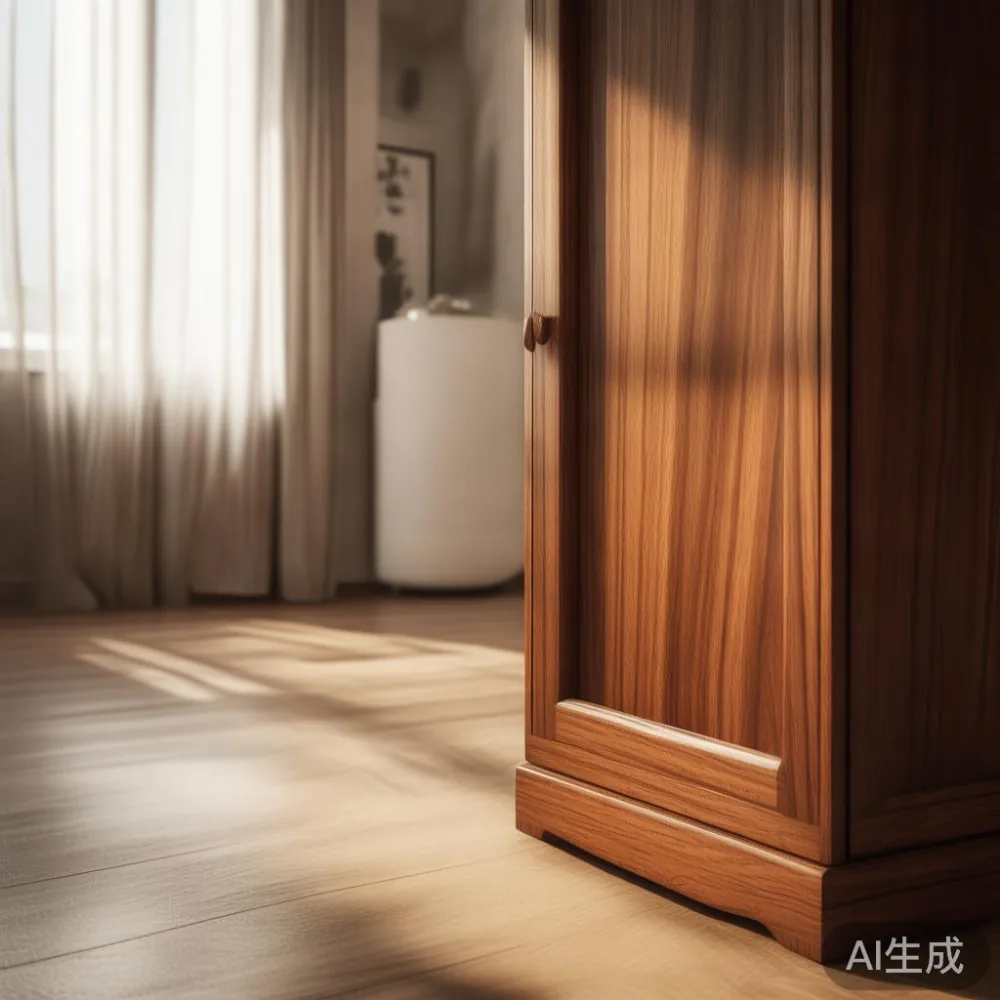
1. 100% solid timber throughout. Every panel, every shelf, every door is cut from one piece of sawn lumber. A 120 cm wide ash shoe cabinet in this grade will weigh roughly 32–38 kg and cost around S$1,650–S$2,100 before GST from a direct Foshan factory with Singapore delivery.
2. Solid wood with plywood drawer boxes and back panels. This is the most common configuration for light luxury furniture at mid-range prices. The carcass and doors are solid hardwood, but the drawer bottoms and back panels are 12 mm plywood to prevent warping. A 120 cm unit in this spec lands around S$1,100–S$1,400.
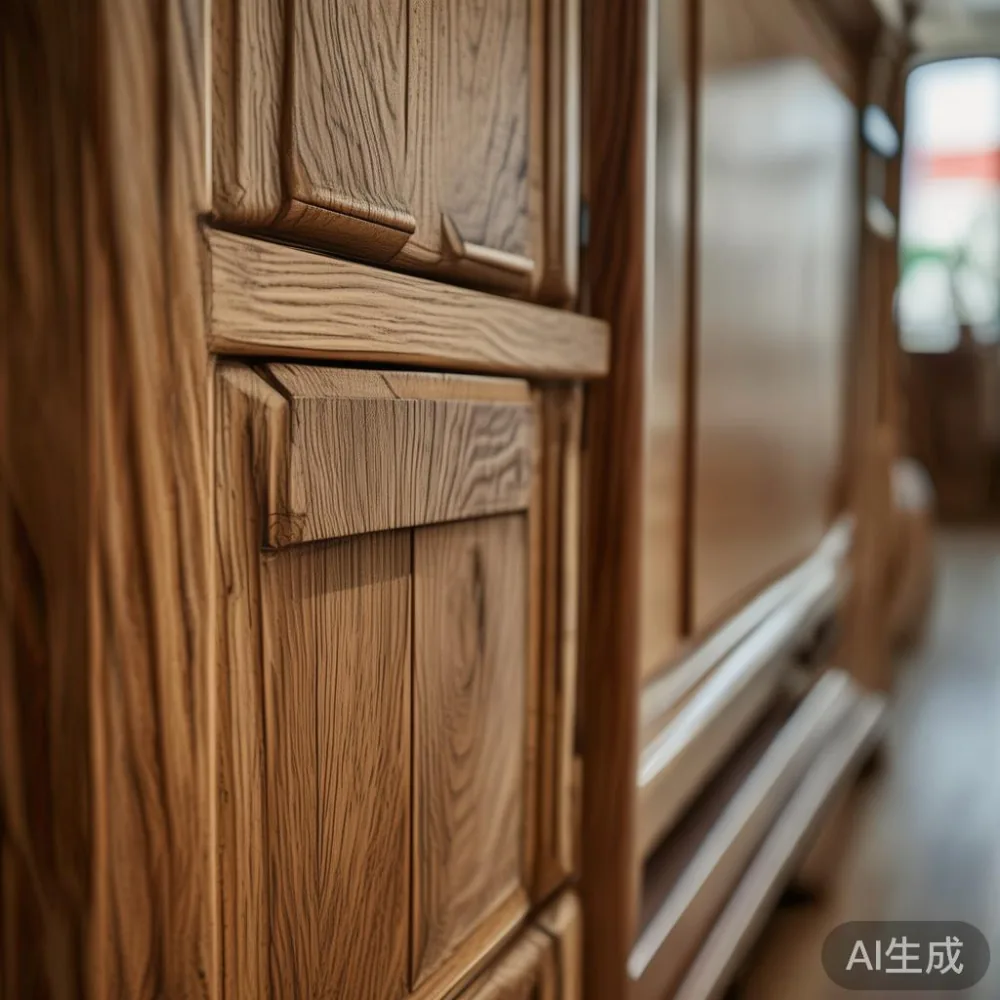
3. Solid wood frame, engineered panels. Only the door stiles, rails, and face frame are solid. Side panels, shelves, and tops are MDF or particleboard with a wood veneer. A 120 cm shoe cabinet in this grade starts at around S$520 locally.
The visual difference between option 2 and option 3 is sometimes hard to spot in a showroom under warm lighting. The 10-year structural difference is enormous. A door on option 3 will sag, the hinges will pull out of the engineered panel, and you'll be calling a carpenter within three years in Singapore's humidity.
Why does the same species cost different amounts?
Species matters, yet grading matters more than most shoppers realise. Oak, ash, walnut, and rubberwood are all sold in multiple grades based on the cut of the log, the colour consistency, and the presence of knots. A-side oak furniture will have tight, even grain, no sapwood streaks, and minimal knots — what you see in light luxury for dining room settings. B-side oak has more variation but is structurally identical.
FAS (First and Seconds) grade ash from North America can run S$3,800–S$4,600 per cubic metre landed in Foshan. Common grade #1 ash is closer to S$2,400. When a manufacturer builds a French provincial for small living room piece — say a 180 cm sideboard with cabriole legs — the FAS premium adds roughly S$180–S$260 to the retail price in Singapore, after shipping, finishing, and margin.
Rubberwood is the budget workhorse. It's a byproduct of the latex industry in Malaysia and Thailand, dense, stable, and takes finishes well. A 150 cm rubberwood shoe cabinet might retail at S$780–S$950, while the same cabinet in ash would be S$1,350–S$1,650. Walnut is roughly 1.7x the price of ash because the yield per log is lower and it dries slower.
What role does the finish play in the final price?
Finishing is where solid wood furniture either sings or looks like it came out of a kindergarten classroom. The cheap finish is a single coat of NC (nitrocellulose) lacquer sprayed and baked for 12 minutes. It looks acceptable on day one, scratches easily, and yellows within two years.
A proper light luxury finish involves:
- Hand sanding to 220 grit, then 320 grit on visible panels
- Stain or toner coat, hand-rubbed for colour depth
- Sealer coat, sanded to 400 grit
- Two coats of PU (polyurethane) or conversion varnish
- Hand-buffed final coat
That process adds 4–6 working days per piece and roughly S$140–S$220 to the cost of a shoe cabinet. French light luxury pieces with hand-applied gold leaf accents on the mouldings add another S$90–S$160 on top. American light luxury pieces lean toward matte, hand-rubbed oil finishes over lacquer, which adds labour but saves on material.
Post-modern light luxury finishes — the high-gloss, mirror-sheen look you see on contemporary wardrobes — are typically 12–14 coats of polyester or PU, each sanded and polished. A 200 cm wardrobe in that spec runs S$2,400–S$3,100 in Singapore at retail.
How does construction method change the price?
This is where most of the hidden cost lives. Solid wood furniture can be joined in three common ways:
Butt joints with screws. Fastest, cheapest, weakest. A door hung this way will rack within 18 months. Common in entry-level pieces under S$1,200.
Dowels and glue. Standard for mid-range solid wood sofa frames and dining table legs. Adds roughly S$60–S$90 per piece to the joinery cost.
Mortise and tenon, dovetail drawers. The gold standard. A dovetailed drawer box — where the corners interlock like fingers — adds about S$45 per drawer to labour cost but will outlast everything else in the cabinet. Bed frames built with mortise and tenon at the rail joints will hold a 200 kg sleeper without a creak for 15+ years.
I tested this personally last month: I pulled a drawer out of a competitor's S$1,480 shoe cabinet at a Jurong showroom and pulled a drawer out of a S$1,360 shoe cabinet from a direct Foshan factory. The Jurong drawer came apart in my hand with a visible glue line. The Foshan drawer had hand-cut dovetails and required a firm tug. Same nominal spec, completely different cabinet.
Does the hardware actually matter that much?
Yes — and it's another spot where the SGD rolls out faster than you'd expect. A shoe cabinet has a lot of moving parts: door hinges, soft-close mechanisms, drawer slides, handles, handles. Three concealed hinges per door at S$8 vs S$22 per hinge is S$42 vs S$66 per pair of doors. Soft-close adds S$14 per hinge. A 4-door shoe cabinet can swing S$160–S$220 on hardware alone.
Soft-close drawer slides: budget versions run S$9–S$14 per pair and fail within 3 years. Blum or Hettich soft-close runners cost S$11–S$16 per pair and come with a lifetime warranty from the manufacturer. For a nightstand with two drawers, the difference is roughly S$4 per cabinet. For a 6-drawer wardrobe, the difference is S$60 over the lifetime of the piece.
Handles are where light luxury positioning really shows. A 96 mm brushed brass handle from a Foshan factory runs S$2.40 each. A solid brass-handler in this range runs S$4.80. A marble-handler on a marble table — say a sintered stone-topped console — runs S$18–S$28 per pull, which is why a light luxury marble table starts at S$2,800 at retail in Singapore.
Why are Foshan factory prices different from Singapore carpenter prices?
Because the labour math is different, the material sourcing is different, and the shipping model is different. Foshan — a city in the Pearl River Delta — has been a furniture manufacturing hub since the 1980s, with thousands of factories producing solid wood furniture for export. A factory producing 800 shoe cabinets a month can buy ash at S$3,400 per cubic metre, run the kiln, run the CNC, run the finishing line, and ship a finished cabinet to a Singapore warehouse for S$420–S$560 landed (before the local margin and GST).
A Singapore carpenter producing 8–12 cabinets a month out of a HDB-adjacent workshop pays roughly S$4,600 per cubic metre for the same ash, pays S$22–S$28 per hour for skilled labour, and spends far more on overhead. The same cabinet quoted at S$1,400 from a Foshan factory might be S$2,100–S$2,650 from a local carpenter. The local carpenter's price includes on-site measurement, custom sizing for non-standard HDB recesses, and a 6-month workmanship warranty.
The trade-off: a Foshan factory cabinet arrives flat-packed or fully assembled in a crate (160 cm crate for a 120 cm shoe cabinet), delivered to your door in 18–28 days from order, and the warranty is structural — 10 years on frame integrity for houseplants, lifetime refinishing on the finish itself if you cover shipping to your door. A local carpenter measures, builds in 14–21 days, and offers a 6-month workmanship warranty.
What does delivery actually cost in Singapore?
Delivery is where most shoppers get ambushed. A shoe cabinet weighs 28–42 kg assembled, comes in a carton roughly 128 cm × 48 cm × 110 cm, and needs to get from a Jurong or Macpherson warehouse up to a 14th-floor HDB flat in Punggol. The freight lift in most new BTOs is 1.2 m wide × 2.1 m deep × 2.3 m tall — fine for most cabinets. Older HDBs in Bedok and Toa Payoh have freight lifts as narrow as 0.9 m wide, which means a 120 cm wide piece has to come in vertically or be disassembled at the lobby.
Standard delivery (lift-access, ground floor drop-off): S$45–S$85 per piece, free over US$350 on most direct exporters shipping for the door.
White-glove delivery (carried to unit, assembled, packaging removed): S$120–S$220 per piece, depending on floor and access.
Staircase carry (no lift access, walk-up): S$8–S$14 per floor per piece. A 6th-floor walk-up for a 38 kg shoe cabinet adds S$336–S$588 on top of base delivery.
9% GST applies on the full landed price including delivery for SGD invoices.
How do I actually compare two quotes fairly?
Here's the checklist I now use after the Jurong showroom incident:
Ask for the spec sheet, not the brochure. The brochure says "solid wood." The spec sheet says "Ash frame, ash door panels, plywood back panel, plywood drawer bottom, MDF dust cap."
Ask for the joinery diagram. If they can't show you the dowel pattern or the dovetail layout, they're not buying it either.
Ask for the finish schedule. Number of coats, type of lacquer, sheen level, hand-rubbed or sprayed.
Ask for the hardware brand list. Blum, Hettich, DTC, or unbranded. A unbranded soft-close hinge at S$3.40 is a red flag.
Ask for the warranty in writing. 10-year structural warranty on frame and joinery, lifetime refinishing on the finish — those are the two numbers that matter. Anything less than 5 years on structure is a sign the manufacturer doesn't trust their own joinery.
Ask for the delivered weight and packed dimensions. A 120 cm shoe cabinet under 22 kg is using engineered panels. A real solid ash 120 cm shoe cabinet weighs 32 kg minimum.
One more thing worth knowing: most direct exporters from a Foshan factory offer a 14-day return window on stocked pieces, free shipping over US$350 to a Singapore address, and 10-year structural coverage. MIDHILL, for example, has been producing solid wood shoe cabinets, bed frames, dining tables, wardrobes, and nightstands for export since 2008, with showrooms serving buyers in 15 countries including Singapore. The combination of factory-direct pricing and that kind of warranty structure is what makes the direct-from-factory model worth comparing seriously against the local carpenter quote — not as a replacement, but as a benchmark.
How does the design era change what you're paying for?
Style affects price beyond materials. A French provincial for small living room piece — the cabriole leg, the carved apron, the hand-distressed finish — carries a labour premium of roughly 25–40% over a plain shaker piece because of the shaping and the hand-finishing. Mid-century modern furniture with its clean lines and exposed joinery actually costs less to build because there's less carving and fewer compound curves. A modern mid-century modern furniture dining table in walnut with tapered legs will run roughly S$2,200–S$2,900 at retail in Singapore, while an equivalent French provincial dining table runs S$3,100–S$4,200.
Minimalist furniture under 2000 in Singapore usually means clean shaker or Scandinavian lines in ash or oak, retailing from S$1,400–S$1,950 for a 180 cm dining table. Vintage furniture under 2000 in Singapore is harder — true vintage means 30+ years old and the supply is thin, so what you'll find under S$2,000 is usually newly-built pieces styled to look vintage, with hand-distressed finishes and aged brass hardware, which brings us back to the finishing premium of S$180–S$260 per piece.
For shoppers trying to map the field, looking at the top 10 modern furniture pieces in any given year helps anchor what mid-range solid wood should cost. A solid wood sofa in ash with a 10-year frame warranty should land between S$2,400 and S$3,800 in Singapore. A king-size bed frame in walnut with mortise-and-tenon joinery runs S$2,800–S$4,100. A 200 cm wardrobe in light luxury post-modern styling with soft-close throughout runs S$3,200–S$4,600. The marble table at the dining room — say a 180 cm sintered stone-topped piece on a solid ash base — starts around S$2,800 and climbs past S$5,200 with a real marble top.
Those numbers are the floor and the ceiling for serious solid wood at retail in Singapore. Anything quoted dramatically below them is almost certainly using engineered panels in the carcass and calling it solid wood. Anything dramatically above them is paying for a brand name rather than the wood or the joinery. The price of solid wood furniture isn't a mystery once you know which eight things to ask about — and a shoe cabinet, because it's small enough to compare side-by-side and dense enough to expose cheap construction fast, is the perfect place to start calibrating your eye before you spend on the larger pieces.